Maturity Engineering for Perpetual Options: Designing Expiry with Funding
My new paper asks which maturity laws a perpetual option can have. One contract is stuck with the exponential law; networks of perpetuals funded on each other's prices can do much better, at a cost.
Contents
I have published a new paper: Maturity Engineering for Perpetual Options: Funding networks, matrix-exponential maturity laws and the limits of concentration (preprint, 18 November 2026, 49 pages, not peer reviewed). It is available on SSRN and ResearchGate. This article is the short version: the question, the main results and what they cost.
The problem: an option that never expires
Perpetual futures have no expiry. A funding payment between longs and shorts, proportional to the gap between the contract price and a reference, keeps the price near that reference. A 2021 proposal observed that the reference need not be the spot price: if it is an option payoff , the contract is an everlasting option, with funding
Its no-arbitrage price is the expected payoff at an independent exponential time:
where is the European value at maturity . That exponential law is the weak point of the instrument. A trader who wants “a one-month option” gets a mixture in which a third of the weight sits on maturities shorter than twelve days and a seventh on maturities longer than two months. Only the mean, , can be chosen, and it is tied to the strength of the anchor.
The paper treats the maturity law as a design variable and asks what funding can and cannot achieve.
One contract alone cannot escape the exponential law
The first result is negative. Take any continuous funding rule that depends on time, the underlying, the contract’s own price and the payoff. If the contract has the same maturity law for every volatility and every payoff in a test class of power payoffs, that law is exponential and the rule is exactly . Linearity is not assumed; it comes out of the proof.
The reason is informational. A contract with maturity density would need to pay
which involves European values at every maturity where . A single contract reveals none of them, except when : then the integral is , its own price. To get a sharper maturity you need information about other maturities: a listed option market, a model, or other perpetual contracts.
Funding networks and the ladder
The paper takes the third route. A funding network is a set of perpetuals on the same payoff whose funding rates are linear in each other’s prices,
Such a network implements a family of maturity densities, as the only prices without a bubble, if and only if the span of the densities is closed under differentiation (). With continuous funding the attainable laws are matrix-exponential of order at most , and phase-type when all cross-funding weights are non-negative.
The simplest example is the ladder: rung 1 is an everlasting option and each rung is anchored to the one below, . Rung then has an Erlang maturity of shape , and with the top rung concentrates around as grows.
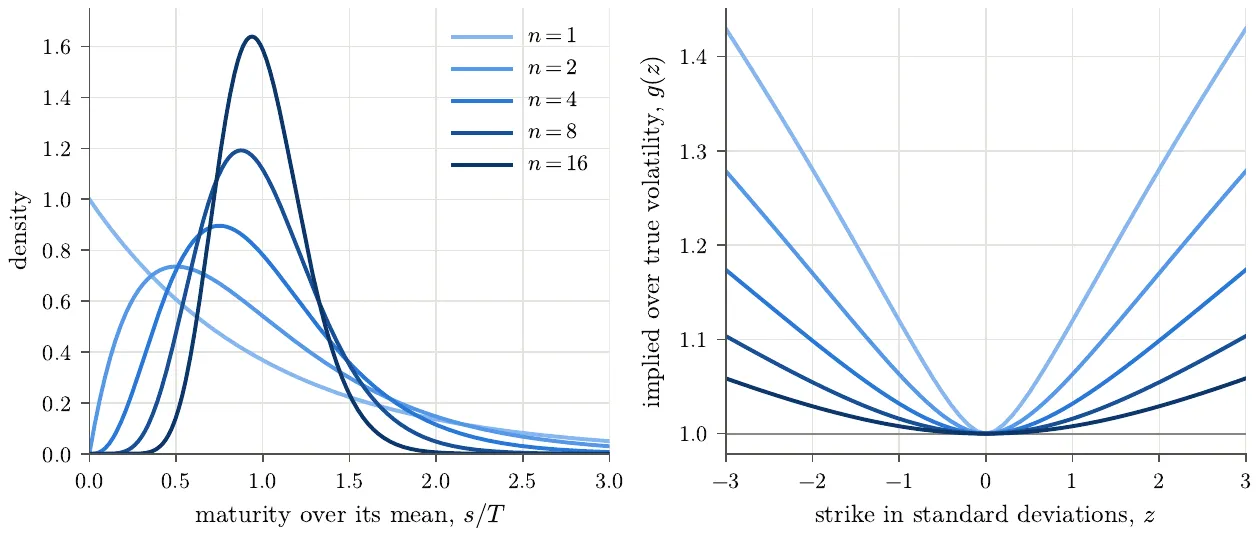
The right panel shows a side effect worth knowing: under constant volatility, a random maturity alone produces a smile. Near the money its curvature is a quarter of the squared coefficient of variation of the maturity, so bounds on dispersion are bounds on the smile.
The limits of concentration
How concentrated can a network make the maturity? With non-negative weights, a theorem of Aldous and Shepp on phase-type laws gives a hard floor: the squared coefficient of variation is at least , attained only by the ladder. Halving the dispersion takes four times as many contracts; a relative dispersion of 10% takes a hundred.
Signed weights do better. Nothing forces a funding weight to be positive: it is a formula applied to observed prices. Three contracts with signed cross-funding reach a squared coefficient of variation of 0.2009, against 1/3 for the three-rung ladder, and networks of odd order inherit the concentrated matrix-exponential laws known in applied probability, whose dispersion falls roughly like according to numerical results in that literature. A ladder with a signed anchor on its top rung keeps a real spectrum and has a proven rate of .
What it costs
Concentration is not free. The paper measures three costs.
Anchoring. The funding matrix is also the anchoring matrix: a mispricing earns a carry . Under a linear-response model, an error injected at the bottom of a ladder travels up as a Poisson wave and takes a time of the order of the mean maturity, divided by the speed of the response, to peak at the top, however many rungs there are.
Liquidity. With makers, order books and an arbitrageur who bears risk, arbitrage between rungs moves a premium up the ladder; it does not remove it. The hedged rungs are nearly one risk, so an arbitrageur who nets them makes splitting a fixed liquidity among books cheap.
Margin. A book short one rung and long the rung below has a capped loss, but a margin charged leg by leg is fifty to more than a thousand times that loss at the 99.9% level. A ladder needs a venue that margins the risk of the whole book, not each contract.
A ladder hedges itself
There is also good news for market makers. A short of the top rung that holds the rungs below with binomial weights is left with a residual given by a difference of order across rungs, in any Markov model, with weights that use no model at all. At a fixed mean maturity that residual is of order for a call under Black–Scholes.
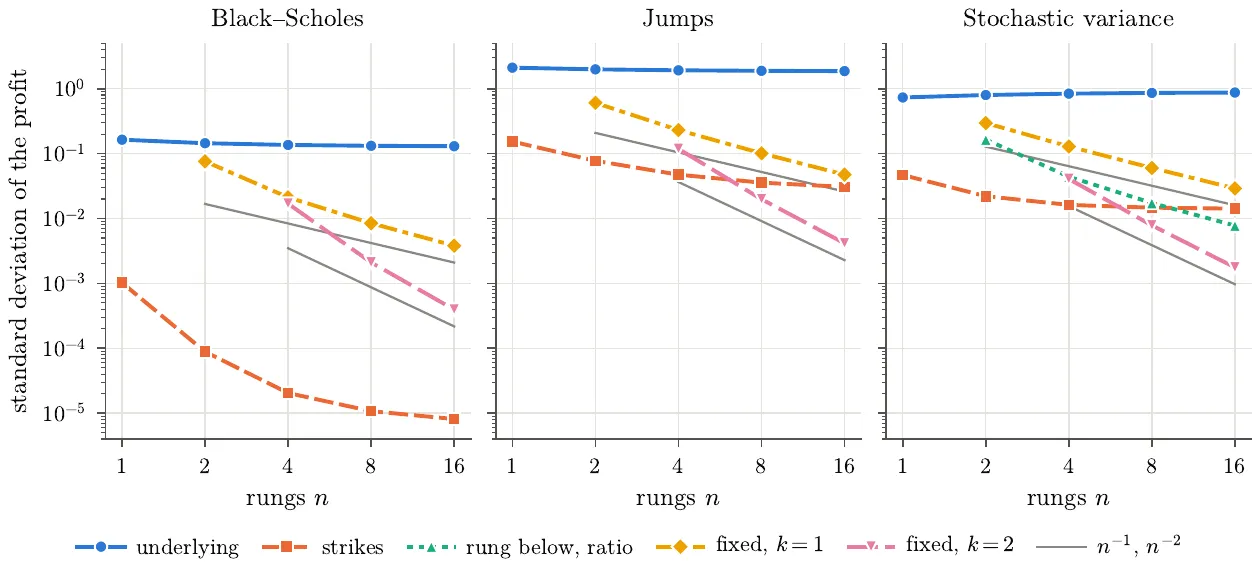
In simulations with jumps and with stochastic variance, from eight rungs on this fixed hedge leaves less risk than hedges with other strikes rebalanced every hour, and its lead grows when the hedger’s model is wrong. Once in place it needs no trading.
What the Deribit data say
Where options of every maturity are listed, the price of a perpetual can be read without a model. The paper does this every day for the Bitcoin and Ether options listed on Deribit from 2019 to 2026. No everlasting option traded on these surfaces; the prices are those of the mixture, without a spread.
- The implied volatility of an everlasting option is, to first order, an average of the listed term structure; its distance from the listed volatility at its mean maturity has a standard deviation of about one to one and a half points.
- Its smile near the money is close to the listed smile plus that of the random maturity, added in variance.
- A hedged holder who bought it at the money every day collected in realised variance 76% to 88% of the funding paid in Bitcoin and 92% to 99% in Ether.
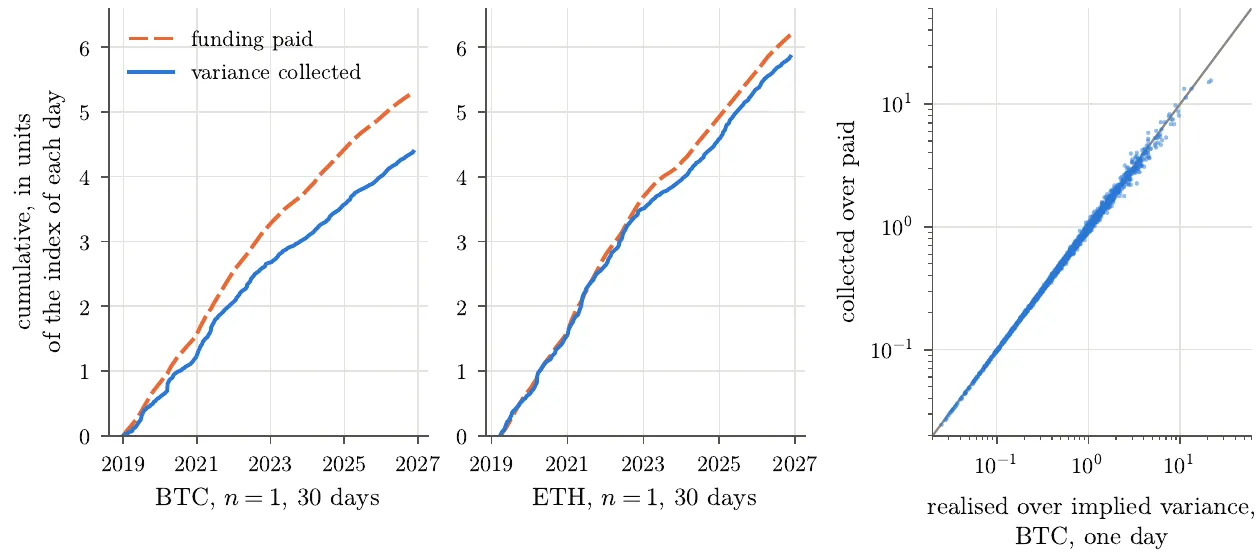
That gap is the variance risk premium, read on the funding of a perpetual instead of on a variance swap.
What this is, and what it is not
This is a contract design. The ladders and networks it describes are not listed on any venue. The paper also covers discrete funding, closed forms for ladders under Black–Scholes, characteristic functions under Lévy models, and the alternative of anchoring a perpetual to an index of option values, which gives a shifted exponential maturity with a single contract. The code behind every number is not public; I provide it on request.
I also recorded a video that walks through the paper in thirteen minutes. This is research, not investment advice.
Video for this article
 Play video: Perpetual options: engineering maturity with funding (YouTube)